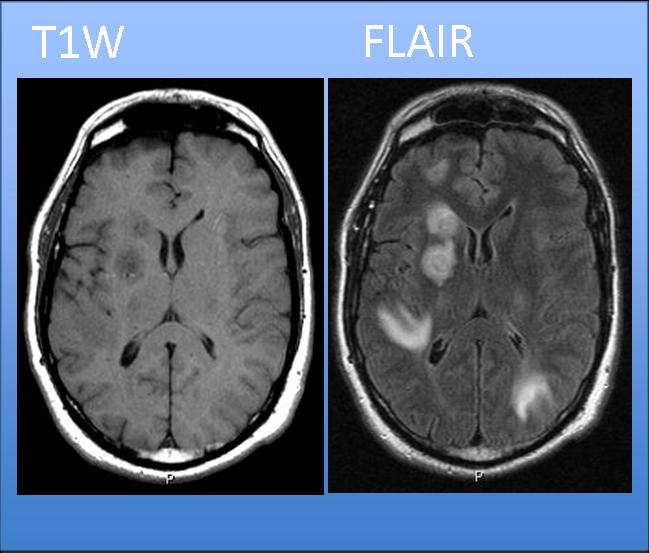
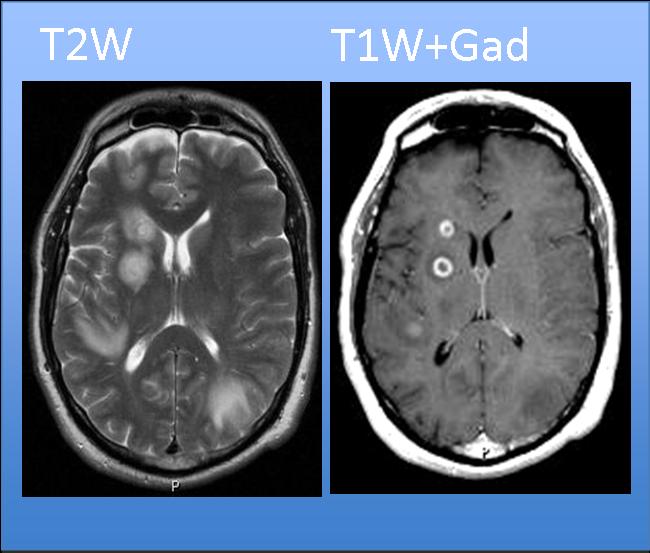
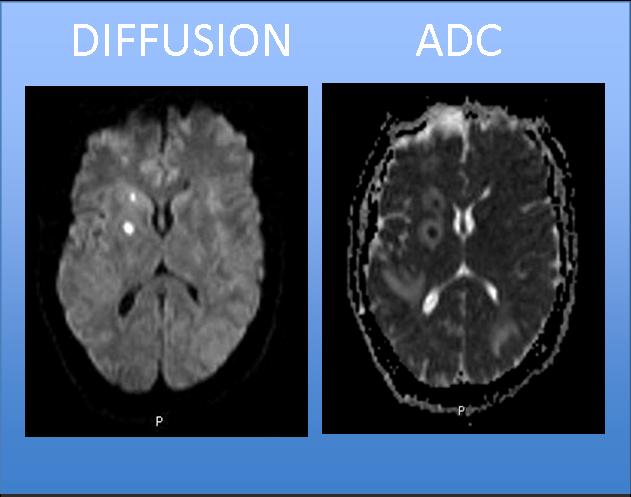
Following the usual pattern of an oral examination (mixed cases from all the subspecialities), I challenge you with the following neuro case, below.
Look out for the answer on Thursday. Good luck!
This week’s patient is a 61-year-old immunocompetent male with progressive disorientation and general weakness
1. Metastases
2. Pyogenic abscess
3. Tuberculosis
4. Multiple Sclerosis
Findings: multiple intraparenchymal hemispheric lesions, with a peripheral rim, oedema and ring enhancement (yellow arrows). Low ADC values on diffusion images (red arrows).
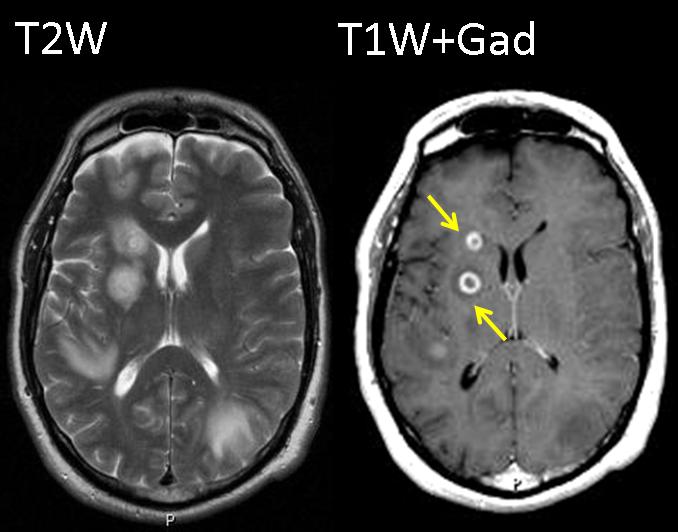
Fig. 4
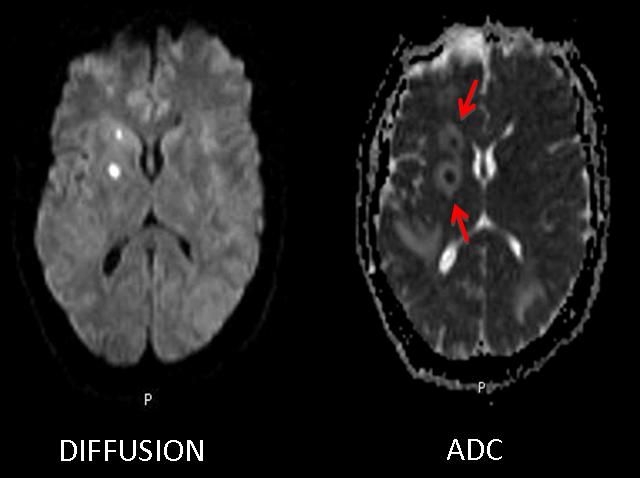
Fig. 5
Although the most common ring enhancing lesions in immunocompetent adult patients are metastases, the low ADC values are very suggestive of brain abscesses. Occasionally, metastasis and MS plaques may demonstrate low ADC values inside the ring enhancing areas; but it is an uncommon finding
Final diagnosis: Pyogenic brain abscesses
Brain abscesses typically demonstrate a complete ring of enhancement with a smooth inner and outer margin and reduced diffusion coefficient, and therefore low signal intensity on the apparent diffusion coefficient map. On MR imaging, tuberculous abscess can present the same findings as pyogenic abcesses. Clinical history, clinical presentation and laboratory tests are the most important clues to make the diagnosis.
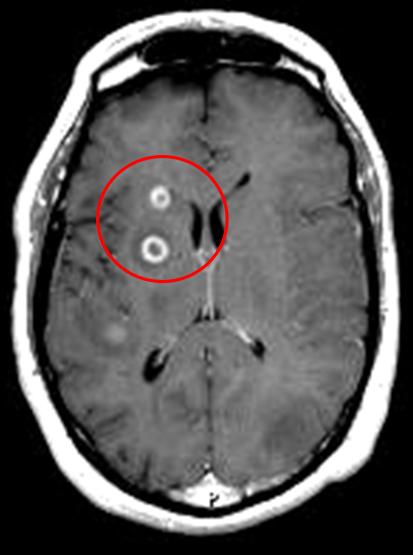
Fig. 6 Continuous ring of enhancement
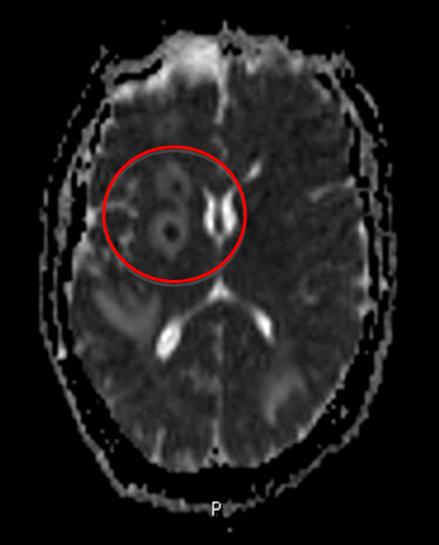
Fig. 7 Low ADC
Differential diagnosis should include metastases, specially in adults and immunocompetent patients. It is important to know the prior clinical history of the patient to make the diagnosis. Ring enhancement and restricted water diffusion also might be found in brain metastases.
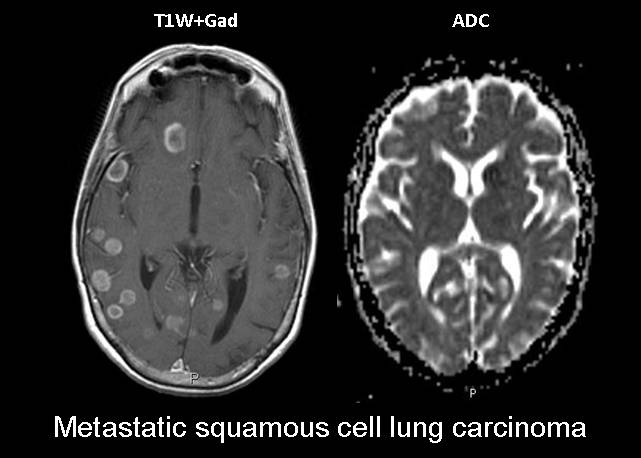
Fig. 8
Patients with MS may present with multiple ring enhancing lesions. The most characteristic finding is an ‘incomplete ring’ of enhancement (arrow). MS plaques show a discontinuous ring that is not demonstrated in cases of metastasis or abscesses.
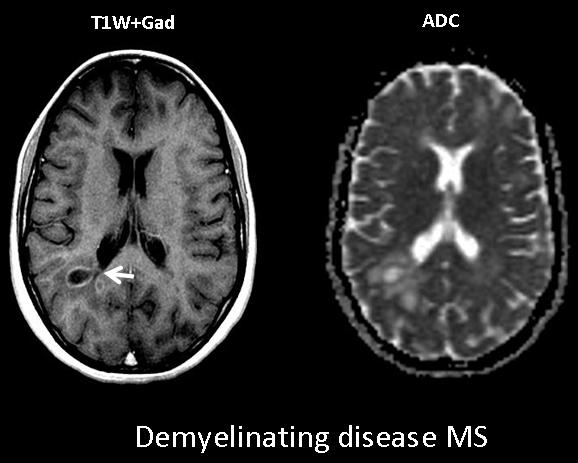
Fig. 9

Follow Dr. Pepe’s advice
- Differential diagnosis of brain ring enhancing lesions should include metastases, abscesses, tuberculosis, MS.
- Low ADC values are highly predictive of abscess, although they are not 100% specific.
- An ‘incomplete ring’ of enhancement suggest demyelination.
Suggested reading. Patterns of Contrast Enhancement in the Brain and Meninges.James G. Smirniotopoulos. RadioGraphics 2007; 27:525–551
Case prepared by Laura Oleaga MD